
FP&A in the Real World: A CMA Perspective


Introduction
Finance today is no longer about closing books or preparing reports after decisions are made. It is about influencing decisions before they happen. At the center of this transformation is Financial Planning and Analysis or FP&A, the function that connects numbers with strategy.
Across industries, FP&A professionals are now trusted advisors to leadership teams. For US CMA students and professionals, FP&A represents one of the most powerful and future aligned career paths in finance.
This blog explores real world FP&A scenarios, a detailed business case study, and why CMA trained professionals are increasingly valued in strategic finance roles. It also explains how the right mentorship can turn FP&A from a syllabus topic into a long term career advantage.
The Strategic Shift of FP&A
FP&A was once viewed as a support function responsible for budgets, forecasts, and variance analysis. That definition no longer applies. In 2025, FP&A plays a central role in shaping business direction.
Modern FP&A teams are expected to
- Partner with business heads on pricing, expansion, and investment decisions
- Anticipate financial risks instead of reacting to them
- Translate operational activity into financial impact
- Support leadership with scenario based insights
Global CFO surveys show that more than seventy percent of major business decisions are now supported by FP&A inputs. This evolution explains why companies prefer professionals with strong management accounting and analytical skills, qualities that are central to the US CMA qualification.
FP&A on the Factory Floor
A mid sized manufacturing company supplying automotive components experienced declining operating margins for two consecutive quarters. Sales volumes were stable, and procurement teams attributed the issue to rising raw material costs.
The FP&A team, led by a CMA qualified professional, challenged this assumption. Instead of focusing only on input prices, they analyzed
- Fixed and variable cost absorption
- Overtime and idle capacity patterns
- Inventory turnover and holding costs
- Production scheduling efficiency
The analysis revealed that poor demand forecasting led to excess inventory during slow periods and overtime costs during peak demand. These inefficiencies were quietly eroding profitability.
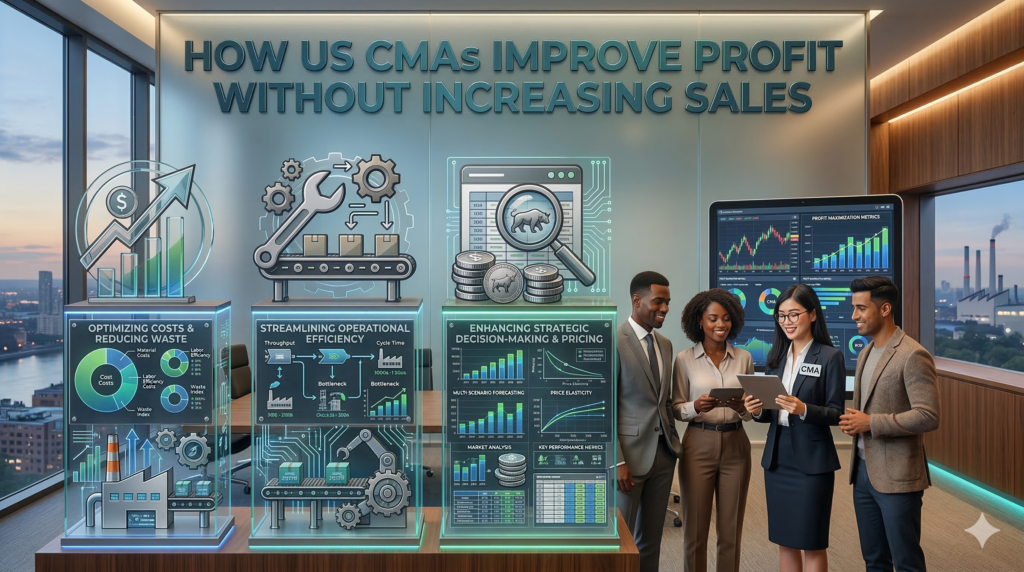
FP&A recommended improved forecasting models, smoother production planning, and tighter inventory controls. Within two quarters, margins stabilized without any increase in selling prices. This scenario highlights how FP&A creates value by identifying root causes rather than surface level problems.
When Growth Hides Margin Loss
Business Context
A fast growing consumer goods company operating across India and Southeast Asia reported consistent revenue growth year after year. Despite this, operating margins were steadily declining. Leadership initially blamed inflation, logistics costs, and competitive pressure.
The CFO assigned the FP&A team a clear mandate. Identify the true drivers of margin erosion and recommend corrective actions within one quarter.
Data Driven Performance Review
Instead of relying on traditional financial statements, FP&A redesigned performance analysis around decision focused metrics. Data was consolidated across products, regions, and channels to analyze
- Contribution margins by SKU and geography
- Discounting patterns versus volume growth
- Marketing spend effectiveness
- Cost behavior across revenue levels
This approach reflects the US CMA focus on performance management and financial planning rather than mechanical reporting.
Challenging Management Assumptions
A deeper analysis revealed several critical insights.
- High growth regions relied heavily on discounting to drive volumes
- Premium products were priced inconsistently across markets
- Marketing budgets were allocated based on historical spending rather than return on investment
Revenue growth was real, but it was being achieved at the expense of profitability. Without FP&A intervention, leadership may have continued chasing topline numbers while margins weakened further.
Forecasting Business Outcomes
FP&A then moved into scenario planning, the most strategic aspect of the role. Multiple forward looking models were created to answer leadership questions.
- What happens if current discounting continues
- How margins respond to selective repricing
- Which products deserve increased marketing investment
Each scenario was linked to projected EBITDA, cash flows, and working capital requirements. Leadership could now evaluate trade offs clearly before making decisions. This forward looking mindset is a core strength of CMA trained professionals.
Execution and Results
Based on FP&A recommendations, management implemented
- Tighter discount approval frameworks
- Selective repricing of premium products
- Reallocation of marketing budgets to high return channels
- Rolling forecasts instead of static annual budgets
Within six months, operating margins improved by more than three percent without any increase in revenue. Profitability improved through better decisions, not cost cutting.
FP&A During Economic Stress
During an economic slowdown, an IT services firm faced client budget cuts and revenue uncertainty. Leadership considered hiring freezes and benefit reductions.
The FP&A team conducted a risk focused analysis covering
- Client concentration and revenue predictability
- Cost flexibility across departments
- Cash runway under multiple demand scenarios
Instead of blanket cost reductions, FP&A recommended pausing low margin projects, protecting high performing teams, and preserving key client relationships. The company avoided layoffs and was well positioned when demand recovered. This scenario reflects the growing importance of FP&A during uncertainty.
Why CMAs Excel in FP&A
The US CMA curriculum is uniquely aligned with FP&A responsibilities because it emphasizes management decision making rather than compliance reporting.
CMAs are trained to
- Analyze cost structures and profitability drivers
- Build budgets, forecasts, and scenarios
- Interpret financial data for non finance stakeholders
- Think like business partners
This is why FP&A roles across manufacturing, FMCG, IT services, consulting, and startups increasingly list US CMA as a preferred qualification. More details about the CMA credential are available at https://www.imanet.org.
The FinStreet Advantage
From Exam Preparation to Career Preparation
Many CMA aspirants complete the syllabus but struggle to apply concepts in real world roles. FinStreet was designed to bridge this gap.
At FinStreet, FP&A is taught as a career skill. Students are trained to think in business scenarios, not just exam questions.
How FinStreet Stands Apart
- Real life case studies inspired by corporate FP&A roles
- Mentorship from professionals with hands on industry experience
- Personalized study and career strategy planning
- Continuous doubt solving and concept reinforcement
- Strong focus on interpretation and decision making
Unlike traditional institutes that stop at exam completion, FinStreet supports long term career growth. Learn more at https://www.finstreetedu.com.
A Smarter Way to Learn CMA
Traditional CMA coaching focuses on syllabus completion. FinStreet focuses on capability building.
Traditional coaching emphasizes memorization.
FinStreet emphasizes application and insight.
Traditional learning is exam focused.
FinStreet learning is career focused.
This approach explains why FinStreet students transition more confidently into FP&A, business finance, and strategic roles. Broader finance career trends are also discussed on platforms like https://www.cfainstitute.org.
Where Finance Meets Influence
FP&A has become one of the most influential functions in modern organizations. Companies no longer want finance professionals who explain what happened. They want professionals who guide what should happen next.
For US CMA aspirants, FP&A offers a career path that is strategic, future proof, and deeply impactful. With the right mentorship and practical exposure, this path becomes far more achievable.
Enroll in FinStreet’s US CMA program today.
Book a free counselling session with FinStreet experts.
Join FinStreet’s CMA newsletter for weekly insights on FP&A and strategic finance.