
Cybersecurity Costs and Financial Risk Management A CMA Perspective

Introduction
Cybersecurity was once seen as an IT issue, something handled quietly by technical teams in the background. Today, it has become a major financial and strategic concern for organizations across the globe. Data breaches, ransomware attacks, and system disruptions are no longer rare events. They are regular business risks with serious financial consequences.
For Certified Management Accountants, cybersecurity is not just about protecting data. It is about managing financial risk, safeguarding organizational value, and supporting informed decision making. Every cyber incident carries direct and indirect costs that can affect profitability, liquidity, reputation, and long term sustainability.
This blog explores cybersecurity costs through the lens of financial risk management and explains why CMAs play a critical role in helping organizations prepare for, respond to, and recover from cyber threats. Through real world examples and practical insights, we also highlight how finance professionals can build this risk focused mindset with support from learning platforms like Finstreet.
Why Cybersecurity Is a Financial Risk, Not Just a Technical One
When a cyber attack occurs, the immediate focus is often on restoring systems and stopping further damage. However, the financial impact goes far beyond IT repair costs.
Cyber incidents can lead to revenue loss, regulatory fines, legal expenses, customer compensation, higher insurance premiums, and long term brand damage. In some cases, companies face operational shutdowns that disrupt cash flows and weaken investor confidence.
A well known example is a global retail company that suffered a ransomware attack, forcing stores to temporarily shut down online operations. While IT teams worked to restore systems, the finance team had to estimate lost sales, assess liquidity needs, and communicate financial risks to stakeholders.
This is where the CMA perspective becomes essential. Cybersecurity is a business risk that must be measured, managed, and planned for financially.
Understanding the True Cost of Cybersecurity
Cybersecurity costs are often underestimated because many of them are not immediately visible. CMAs help organizations identify and categorize these costs to support better decision making.
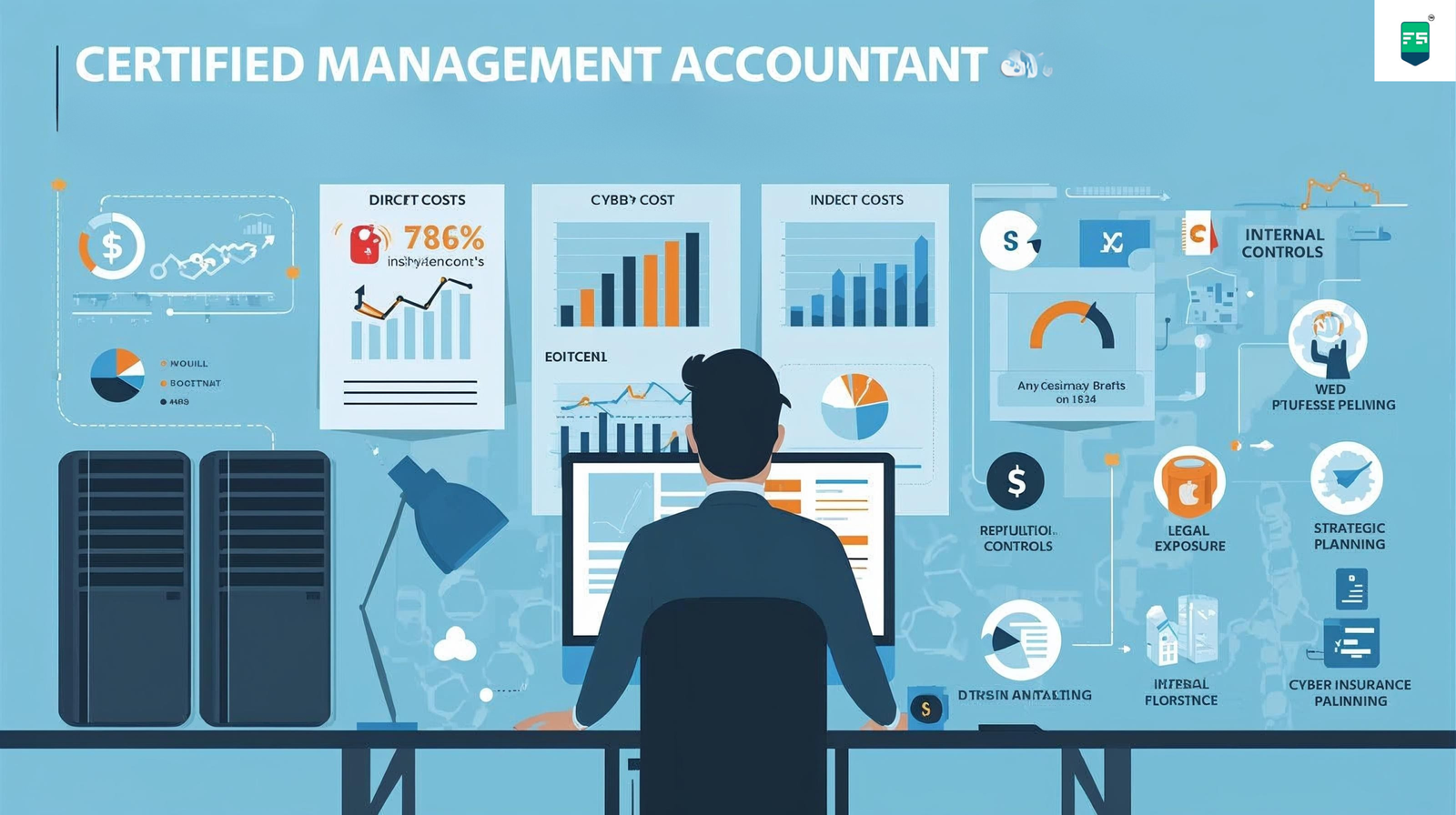
Direct Cybersecurity Costs
These are costs that can be clearly identified and measured.
| Type of Cost | Examples |
| Prevention costs | Firewalls, encryption tools, security software |
| Detection costs | Monitoring systems, audits, penetration testing |
| Response costs | Incident response teams, system recovery |
| Compliance costs | Regulatory reporting, legal consultations |
These costs are usually budgeted and approved, making them easier to track.
Indirect and Hidden Costs
Indirect costs are often more damaging and long lasting.
| Type of Cost | Examples |
| Revenue loss | Business downtime, cancelled orders |
| Reputation damage | Loss of customer trust |
| Legal exposure | Lawsuits, settlements |
| Operational disruption | Delays, productivity loss |
CMAs play a key role in quantifying these hidden costs and highlighting their impact on long term financial performance.
Cybersecurity as a Risk Management Issue
Risk management involves identifying potential threats, assessing their impact, and implementing controls to mitigate them. Cyber threats fit perfectly into this framework.
From a CMA perspective, cybersecurity risk management includes estimating the likelihood of attacks, assessing financial exposure, and evaluating the cost effectiveness of preventive measures.
For example, investing in advanced security systems may seem expensive. However, when compared with the potential cost of a major data breach, the investment often proves justified.
A CMA working in a financial services firm once shared how management initially resisted investing in upgraded security infrastructure. By presenting a risk analysis comparing preventive costs with estimated breach losses, the finance team successfully justified the investment. Months later, the system prevented a major attempted attack.
This highlights how financial insight supports smarter risk decisions.
Budgeting for Cybersecurity the CMA Way
One common challenge organizations face is deciding how much to spend on cybersecurity. Overspending can strain resources, while underspending increases vulnerability.
CMAs help strike this balance by integrating cybersecurity into budgeting and forecasting processes. Instead of treating it as a one time expense, cybersecurity is viewed as an ongoing risk management investment.
Effective cybersecurity budgeting considers factors such as industry risk exposure, regulatory requirements, data sensitivity, and business size.
Learning platforms like Finstreet emphasize risk based budgeting and strategic cost analysis, helping finance professionals understand how to allocate resources effectively. You can explore relevant finance and risk management programs at https://www.finstreet.in.
Cybersecurity and Internal Controls
Internal controls are a core area of CMA expertise. Cybersecurity is closely linked to internal control systems that protect assets and ensure reliable financial reporting.
Weak cybersecurity controls can lead to unauthorized access, data manipulation, and financial fraud. CMAs work with IT and compliance teams to design controls that reduce these risks.
Examples include access controls, segregation of duties, approval workflows, and audit trails. These controls not only protect systems but also support accurate financial reporting.
When cybersecurity controls are strong, financial data integrity improves, supporting better decision making and regulatory compliance.
Role of CMAs in Cyber Risk Assessment
CMAs contribute significantly to cyber risk assessments by translating technical risks into financial terms that management can understand.
Rather than focusing on technical jargon, CMAs ask questions such as how much revenue could be lost if systems go down for a day, what fines could arise from data breaches, and how insurance coverage would respond.
This financial framing helps leadership prioritize risks and allocate resources effectively.
A manufacturing company once underestimated cyber risk because it believed attacks targeted only tech firms. A CMA led a risk assessment showing how production delays from a system shutdown could disrupt supply chains and cash flows. This changed management perception and led to improved cyber preparedness.
Cyber Insurance and Financial Decision Making
Cyber insurance has become an important risk transfer tool. However, purchasing insurance without understanding coverage limitations can create false security.
CMAs analyze insurance policies to ensure coverage aligns with actual risk exposure. They assess premiums, deductibles, exclusions, and claim processes.
Cyber insurance decisions should be integrated into overall financial risk management strategies rather than treated as standalone solutions.
This analytical approach is increasingly taught in professional finance education, including programs supported by Finstreet, which focus on practical risk management decision making.
Integrating Cybersecurity into Strategic Planning
Cybersecurity risks can influence strategic decisions such as digital transformation, mergers, or expansion into new markets.
For example, acquiring a company with weak cybersecurity controls can expose the acquirer to unexpected risks and costs. CMAs play a role in due diligence by assessing cyber related financial risks.
Strategic planning without considering cybersecurity can lead to costly surprises. CMAs ensure that cyber risks are factored into long term plans and investment decisions.
Preparing Finance Professionals for Cyber Risk Management
As businesses become more digital, cyber risk management skills are becoming essential for finance professionals. CMAs are expected to understand how cyber threats affect financial stability and performance.
This requires continuous learning and exposure to real world cases. Platforms like Finstreet support this development by offering industry aligned content that connects finance, risk management, and strategic decision making.
Rather than focusing only on calculations, such learning emphasizes judgment, analysis, and communication.
Simple Illustration of CMA Involvement in Cyber Risk
| Area | CMA Contribution |
| Budgeting | Risk based cybersecurity budgeting |
| Risk assessment | Quantifying financial impact of cyber threats |
| Internal controls | Strengthening financial and data controls |
| Decision support | Evaluating cost benefit of security investments |
| Strategic planning | Integrating cyber risk into long term plans |
This table highlights how CMAs add value beyond traditional accounting roles.
Conclusion
Cybersecurity is no longer a back office concern. It is a financial risk that can threaten business continuity, profitability, and long term sustainability.
From a CMA perspective, managing cybersecurity costs is about balancing prevention, preparedness, and financial resilience. By quantifying risks, supporting informed budgeting, strengthening controls, and guiding strategic decisions, CMAs play a crucial role in protecting organizational value.
As digital threats continue to evolve, finance professionals who understand cybersecurity risk management will remain highly relevant. Developing this capability requires not just technical knowledge but also strategic thinking and ethical judgment.
Platforms like Finstreet contribute meaningfully to this journey by preparing finance professionals to handle modern risks with confidence and clarity.