
How US CMAs Improve Profit Without Increasing Sales

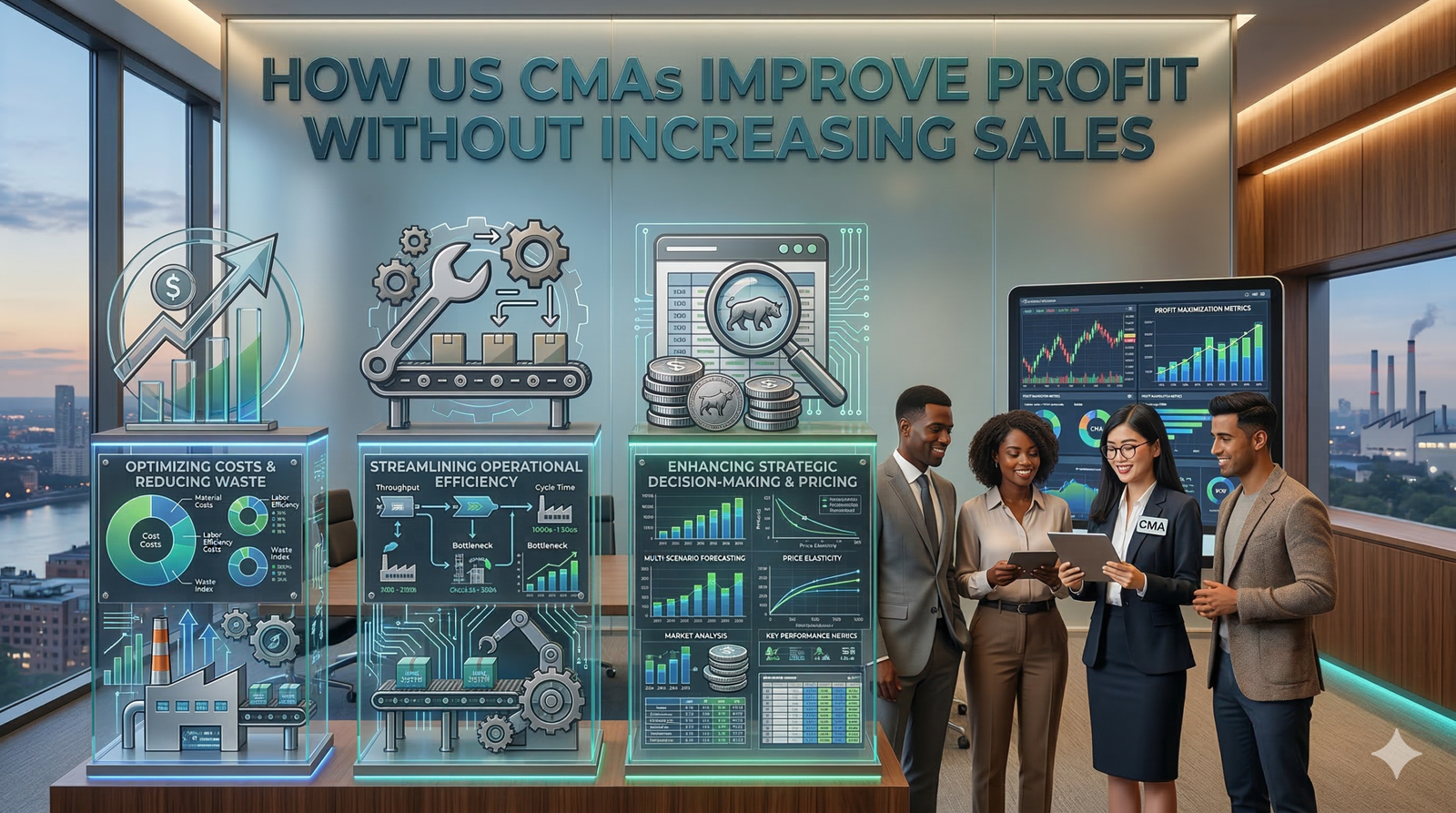
Is increasing sales the only way to grow profit, or can businesses become more profitable without selling a single extra unit?
Many companies assume that revenue growth is the only path to higher profitability. When margins shrink, organizations often increase sales targets, expand marketing budgets, and offer discounts to drive volume. While increasing revenue can help, it is not always the most efficient strategy for improving profit margins.
In reality, businesses can significantly increase profit without increasing sales by focusing on internal financial strategies such as cost control, pricing optimization, and operational efficiency.
This is where professionals with the US CMA Certification play a critical role. US CMA professionals specialize in management accounting, cost management techniques, financial planning and analysis, and strategic decision-making. Their expertise allows organizations to improve profitability by optimizing internal processes rather than simply chasing higher revenue.
In this guide, we explore how US CMA professionals improve business profitability without increasing sales and why this skill is highly valuable in today’s competitive business environment.
Understanding the Real Drivers of Business Profitability
Profitability is influenced by more than just revenue. Businesses must also consider factors such as:
-
Cost structure
-
Resource allocation
-
Operational efficiency
-
Risk management
Many organizations focus heavily on sales growth while ignoring internal financial inefficiencies that quietly reduce profit margins.
Professionals trained through the US CMA Certification approach business challenges from a management accounting perspective. Instead of asking “How can we sell more?”, they analyze deeper questions such as:
-
Are we pricing our products correctly?
-
Are certain products generating low margins?
-
Are operational processes increasing costs unnecessarily?
-
Are resources being allocated efficiently?
By addressing these questions using financial analysis and data-driven insights, companies can significantly improve profit margins without increasing revenue.
Cost Structure Analysis and Margin Improvement
One of the most powerful cost management techniques used by US CMA professionals is cost structure analysis.
Every business operates with a mix of fixed costs and variable costs. Understanding how these costs behave is essential for improving profitability.
Many companies assume that declining profits are caused by weak sales. However, detailed contribution margin analysis often reveals hidden inefficiencies such as:
-
Increasing logistics expenses
-
Inefficient procurement contracts
-
Rising overhead costs
-
Underutilized production capacity
By identifying these issues, US CMA professionals can implement cost optimization strategies that immediately increase profit margins without requiring additional sales.
Institutes such as Finstreet Education emphasize practical applications of cost management and financial analysis within their training programs so that professionals can apply these concepts effectively in real business environments.
Strategic Pricing Strategies to Improve Profit Margins
Pricing is one of the most powerful drivers of profitability, yet many businesses rely on assumptions rather than data when making pricing decisions.
Through financial planning and analysis, US CMA professionals evaluate:
-
Customer profitability
-
Price elasticity
-
Cost absorption
-
Competitive positioning
This analysis often reveals that certain products or customers generate high revenue but low contribution margins.
By implementing strategic pricing strategies for profitability, companies can:
-
Adjust prices based on value rather than volume
-
Discontinue low-margin offerings
-
Focus on high-margin customers
-
Improve overall profit margins
Even a small improvement in pricing strategy can significantly increase profitability without increasing total sales.
Eliminating Operational Inefficiencies Through Performance Management
As companies grow, operational processes often become more complex. This complexity can create inefficiencies that increase costs without adding value.
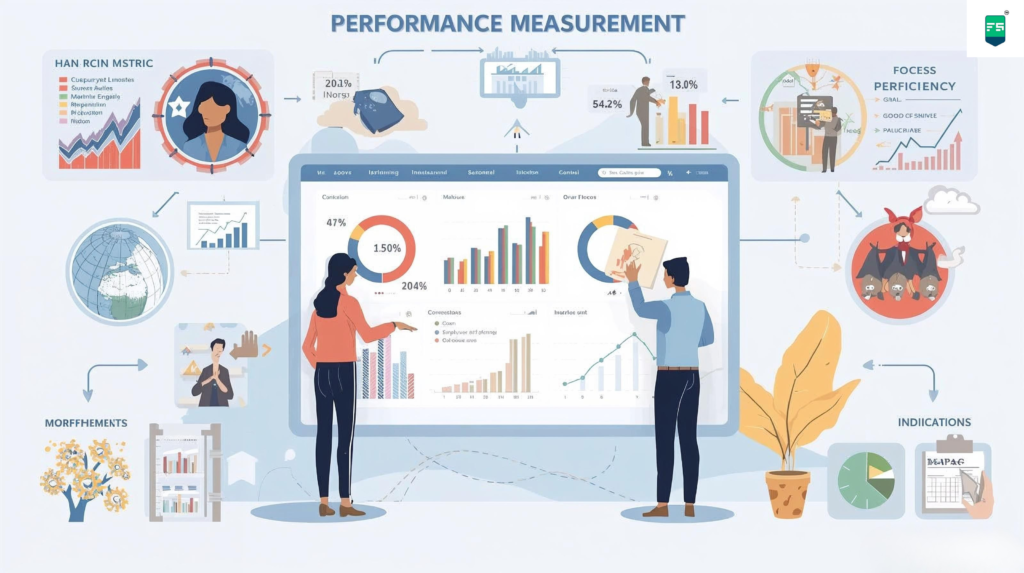
Professionals trained in management accounting and performance management systems design financial metrics that align with strategic business goals.
US CMA professionals regularly perform variance analysis, comparing budgeted performance with actual results. When deviations occur, they investigate root causes rather than simply reporting the numbers.
For example, if production costs increase unexpectedly, they analyze:
-
Material usage
-
Labor efficiency
-
Supplier contracts
-
Production processes
By identifying inefficiencies and implementing improvements, companies can significantly increase profit margins through operational efficiency.
Product Mix Optimization for Higher Profitability
Not all products contribute equally to a company’s profitability.
Some products generate high contribution margins, while others barely cover their costs. However, businesses often focus on total revenue rather than product-level profitability analysis.
US CMA professionals use contribution margin analysis and product mix optimization to determine which products deliver the highest financial value.
By prioritizing high-margin products and reducing emphasis on low-margin offerings, companies can improve profitability without increasing sales volume.
This approach is particularly effective in industries such as:
-
Manufacturing
-
Retail
-
E-commerce
-
Service-based businesses
Strategic product mix decisions allow companies to maximize profitability using their existing resources.
Improving Working Capital and Cash Flow Efficiency
Another important factor influencing profitability is working capital management.
Companies may generate consistent revenue but still experience financial pressure due to:
-
Delayed customer payments
-
Excess inventory
-
Inefficient receivables management
These issues increase borrowing costs and reduce net profit.
US CMA professionals analyze working capital cycles, inventory turnover, and receivables management to improve liquidity and reduce financing expenses.
Better cash flow management strengthens financial stability and directly improves profitability without requiring additional sales growth.
Training programs offered by Finstreet Education incorporate real-world case studies to help students understand how financial planning and analysis techniques influence business profitability.
Using Data Analytics for Profit Improvement
Modern organizations generate large volumes of financial and operational data. However, raw data alone does not improve decision-making.
US CMA professionals use data analytics in finance and financial modeling to identify trends, forecast outcomes, and evaluate strategic options.
Through scenario analysis and predictive financial modeling, they help management understand how different decisions affect profitability.
For example:
-
Reducing spending on low-return marketing channels
-
Improving cost efficiency in supply chains
-
Optimizing operational workflows
These data-driven financial decisions help businesses increase profit margins while maintaining stable revenue levels.
Risk Management and Financial Stability
Unexpected risks such as supply chain disruptions, currency fluctuations, and regulatory changes can quickly erode profitability.
Professionals with the US CMA Certification are trained in risk management and internal control frameworks that help organizations identify potential threats early.
By implementing effective financial risk management strategies, businesses can prevent sudden margin deterioration and maintain long-term financial stability.
Risk management may not directly increase revenue, but it plays a crucial role in protecting profit margins and ensuring sustainable growth.
The Strategic Role of US CMA Professionals in Modern Businesses
Improving profit without increasing sales reflects mature financial management and strategic leadership.
US CMA professionals are not just accountants. They act as strategic business partners who collaborate with leadership teams, operations departments, and marketing teams to align financial strategies with business objectives.
Their expertise in:
-
Cost management
-
Financial planning and analysis
-
Strategic decision support
-
Performance management
allows organizations to build sustainable profitability and long-term competitive advantage.
Institutions such as Finstreet Education help prepare aspiring finance professionals to develop these high-impact skills through structured training programs.
Conclusion
Increasing sales is not the only way to improve profitability. In many cases, the most sustainable growth comes from optimizing internal financial systems, improving cost control, refining pricing strategies, and strengthening operational efficiency.
Professionals with the US CMA Certification are uniquely equipped to drive these improvements through management accounting strategies, cost management techniques, and financial analysis.
In competitive markets where margins are tight and customer acquisition costs are rising, the ability to increase profit without increasing sales provides businesses with a powerful strategic advantage. Ready to build these high-income skills? Explore our certification programs at Finstreet Education today.