
Want to Clear ACCA in Your First Attempt? It’s Not About Studying More, It’s About Studying Smart

Introduction
ACCA is one of the most respected professional finance qualifications globally. Every year, thousands of aspirants attempt to crack it, and a large number aim to clear it on their first attempt. The most common misconception among aspirants is that success depends solely on studying for long hours. While dedication matters, clearing ACCA in the first attempt is not about studying more; it’s about studying smart.
Studying smart involves understanding exam patterns, focusing on high-impact topics, practicing consistently, and building strategic time management skills. It is about making every hour count rather than burning out with endless reading.
In this blog, we explore effective strategies to clear ACCA in the first attempt, provide real-world examples, discuss time management and exam strategy, and show how platforms like Finstreet can help aspirants prepare efficiently.
Understanding ACCA and Its Challenges
ACCA, or the Association of Chartered Certified Accountants, covers a wide range of topics including financial reporting, management accounting, taxation, audit, and ethics. Unlike traditional degrees, ACCA tests not just memory but also analytical thinking, application of concepts, and decision-making skills.
The challenges for first-time candidates include:
- Volume of Syllabus – With over a dozen papers, the syllabus is vast.
- Time Pressure – Exams often require completing multiple questions in limited time.
- Application Focus – Questions are scenario-based rather than purely theoretical.
- Exam Anxiety – First-time candidates may struggle with stress and time management.
Strategy 1: Focus on High-Impact Topics
Not all topics carry equal weight in ACCA exams. Candidates who focus smartly on high-yield topics often outperform those who try to cover everything superficially.
For example, in Financial Reporting (FR), topics like revenue recognition, financial instruments, and lease accounting consistently appear in exams. In Management Accounting (MA), budgeting, variance analysis, and decision-making techniques are crucial.
Tip: Analyze past 5-year exam trends to identify high-frequency topics.
| Paper | High-Impact Topics | Suggested Focus (%) |
| FR | Revenue, Leases, IFRS adjustments | 40% |
| MA | Budgeting, Costing, Variance Analysis | 35% |
| FTX/FIT | Ethics, Governance, Decision Making | 25% |
Focusing on these areas does not mean ignoring the rest but ensures that first-time candidates maximize their scoring potential.
Strategy 2: Practice Application, Not Just Theory
ACCA exams reward application over rote learning. Simply memorizing concepts is not enough; you must know how to apply them in real-world scenarios.
Take an example from Audit and Assurance (AA): a question may describe a small company with unusual transactions. The candidate must identify audit risks, propose procedures, and calculate materiality—not just recite standards.
Real-Life Tip: Many successful first-attempt candidates simulate exam conditions by practicing past papers under timed conditions. This builds both speed and confidence.
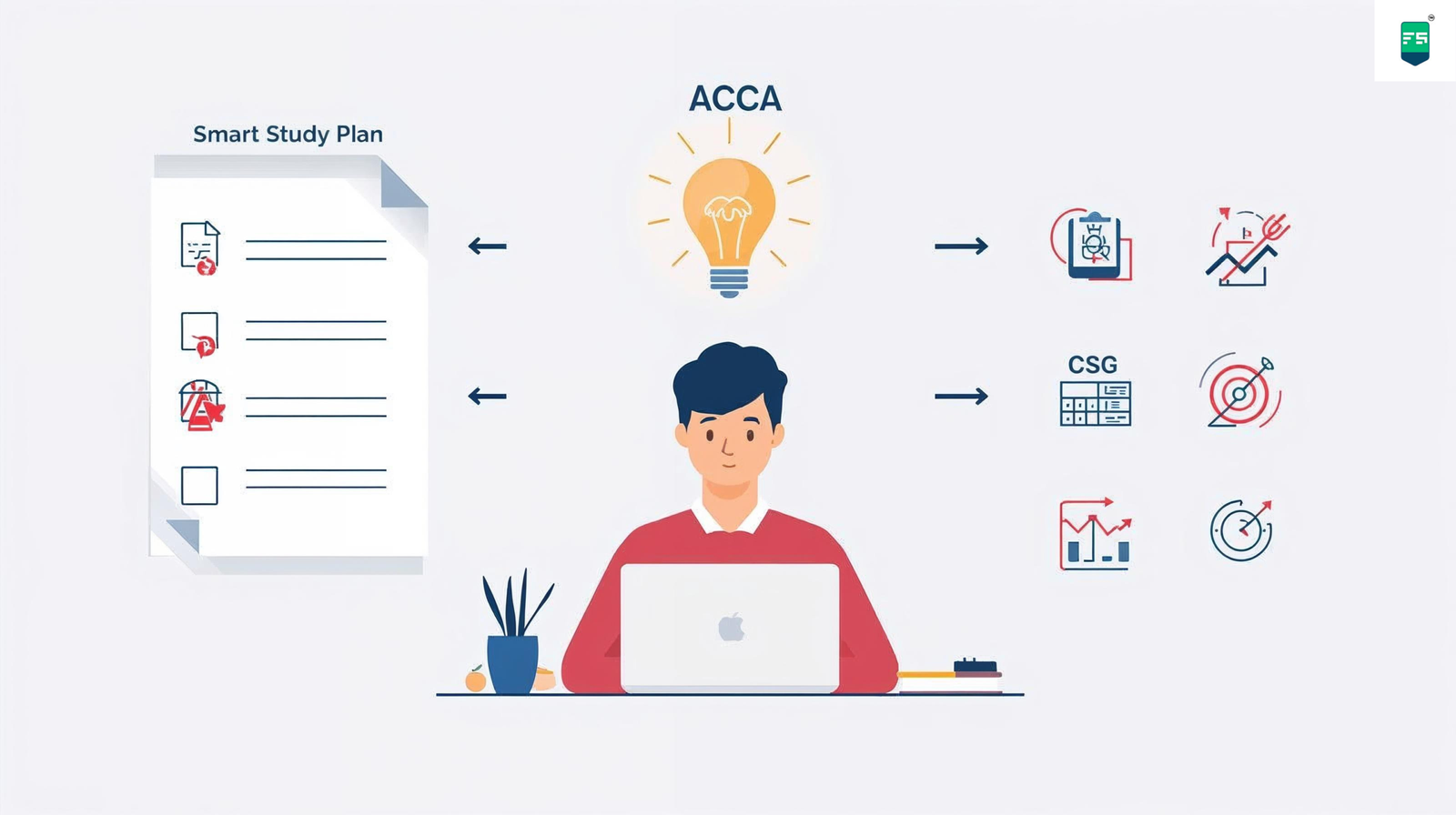
Strategy 3: Create a Smart Study Schedule
Time management is a critical factor in clearing ACCA in the first attempt. Smart study schedules balance study hours, revision, and breaks.
A suggested schedule for a paper like FR could be:
- Week 1–2: Study IFRS concepts with focus on revenue, leases, and financial instruments
- Week 3–4: Practice past exam questions for these topics
- Week 5: Study other topics and weaker areas
- Week 6: Mock exams under timed conditions
- Week 7: Final revision and formula/summary sheets
Tip: Consistency is more important than marathon study sessions. 2–3 focused hours daily are more effective than 10 hours of distracted reading.
Strategy 4: Leverage Online Learning Platforms
Platforms like Finstreet provide structured courses, concise study notes, and mock exams that save time and improve focus. Their approach helps candidates prioritize high-impact topics, practice application-based questions, and track progress systematically.
One student shared:
“I spent years trying to study from multiple books and notes. Once I started using Finstreet’s ACCA crash course and focused mock exams, I cleared FR and MA in my first attempt. It was about quality, not quantity.”
Such personalized, focused learning is a hallmark of studying smart.
Strategy 5: Develop Exam Techniques
Smart preparation is incomplete without exam techniques.
- Read Questions Carefully: Many candidates lose marks by misinterpreting scenarios.
- Allocate Time Per Question: Know how many marks each question carries and manage time accordingly.
- Answer Structurally: For scenario questions, use frameworks: identify the problem, apply the rule, explain reasoning, and conclude.
- Use Bullet Points When Needed: For descriptive answers, clarity matters more than volume.
Example: In Performance Management, instead of writing lengthy paragraphs for variance analysis, summarize calculations and insights in a structured table.
Strategy 6: Focus on Revision and Consolidation
Revision is where smart study pays off. Simply reading notes again is less effective than:
- Solving mock exams under timed conditions
- Creating summary sheets for formulas, ratios, and key standards
- Teaching concepts to a peer or yourself (explaining reinforces learning)
A study by CMA aspirants showed that candidates who spent 20% of total study time on focused revision scored 15–20% higher than those who did not.
Strategy 7: Take Care of Mental and Physical Health
Smart studying also means maintaining health. Burnout reduces efficiency, memory retention, and exam performance.
- Take regular short breaks (Pomodoro technique works well)
- Exercise and maintain proper sleep
- Practice stress management techniques like meditation
A finance professional once shared that taking a 15-minute walk after each 2-hour study session drastically improved focus and memory retention during exam preparation.
The Role of Mindset
Believing that you can clear ACCA in the first attempt is as important as studying. Many candidates fail not due to lack of knowledge but due to self-doubt and exam anxiety.
Smart studying involves positive reinforcement: tracking small wins, practicing regularly, and visualizing success. This mindset improves both learning efficiency and confidence during the exam.
Integrating Smart Study with CMA Skills
For aspirants planning to pursue US CMA alongside ACCA, the approach overlaps significantly. Both qualifications reward:
- Analytical thinking
- Practical application of accounting concepts
- Strategic decision making
By focusing on smart study techniques for ACCA, candidates simultaneously build a strong foundation for CMA exams. Platforms like Finstreet provide resources for both ACCA and CMA aspirants, ensuring study efforts are efficient and aligned.
Case Study: How Smart Study Helps First-Time Pass
Consider Priya, an ACCA aspirant from India. Initially, she studied 10–12 hours a day but barely covered half the syllabus. She switched to a smart study plan:
- Focused on high-weight topics
- Practiced past papers under timed conditions
- Used summary sheets and Finstreet mock exams
- Allocated time for revision and mental health
Result: Priya cleared FR, MA, and FTX in her first attempt. She emphasizes that it wasn’t the number of hours that mattered—it was how efficiently she used them.
Summary Table: Smart vs Hard Study
| Aspect | Hard Study (Less Effective) | Smart Study (First Attempt Focused) |
| Study Hours | Long, inconsistent | Focused, consistent |
| Topic Coverage | Tries to cover everything superficially | High-impact topics prioritized |
| Practice | Minimal application | Mock exams and past papers |
| Revision | Rare or last-minute | Regular, structured, timed |
| Exam Strategy | None | Time allocation, structured answers, scenario analysis |
| Stress Management | Ignored | Regular breaks, mental health focus |
Conclusion
Clearing ACCA in your first attempt is achievable, but it requires a shift from “study more” to “study smart.” Focusing on high-impact topics, practicing application-based questions, building a strategic study schedule, leveraging online platforms like Finstreet, and maintaining health and mindset are all critical components.
Success is not about clocking endless hours but about learning efficiently, applying knowledge effectively, and approaching the exam with confidence. For ambitious aspirants, combining smart study strategies with the right guidance can make the first attempt not just possible, but a stepping stone toward a rewarding finance career.