
US CMA Placement and Job Opportunities


Introduction
When students consider pursuing the US CMA, the biggest concern is rarely about the syllabus or exam difficulty. The real question is far more practical and pressing. What happens after the certification?
In a job market where traditional degrees no longer guarantee employment, students and parents are increasingly focused on placements, job roles, salary growth, and long term stability. This concern is valid. Finance roles are evolving rapidly, and not every qualification aligns with what companies actually need today.
The US CMA stands out because it is not designed as a purely academic credential. It is structured to meet real corporate requirements. However, understanding placement outcomes requires looking beyond pass rates and focusing on how the qualification fits into the current job market.
How the Finance Job Market Has Changed in Recent Years
The US CMA is awarded by the Institute of Management Accountants and is globally recognized for management accounting and strategic finance expertise.
Over the last decade, finance departments have undergone a major transformation. Automation, ERP systems, and AI driven reporting tools now handle much of the routine accounting work that once required large teams. As a result, companies no longer hire finance professionals only to record transactions or prepare historical reports.
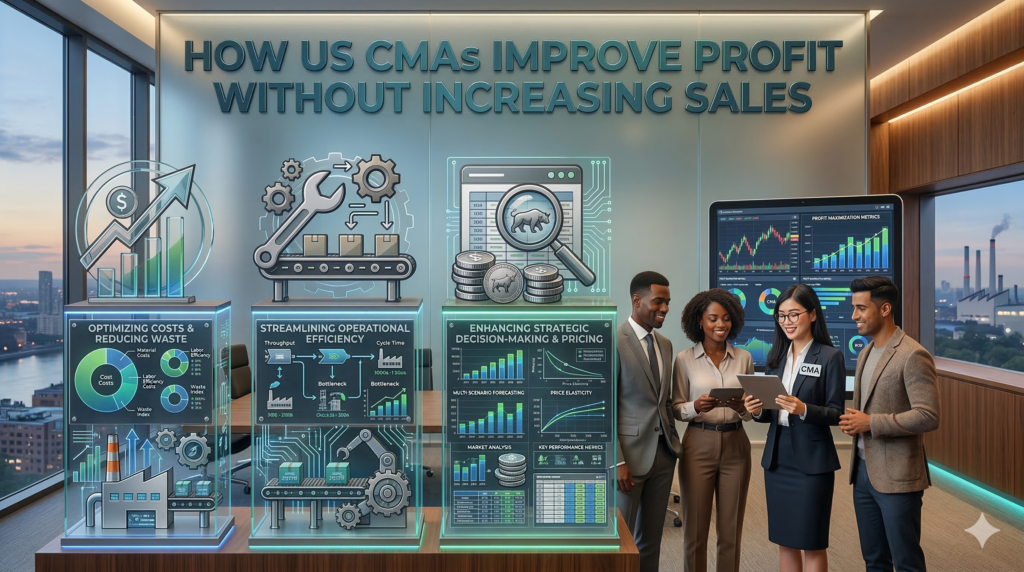
Today, finance teams are expected to support leadership decisions, manage costs proactively, forecast outcomes, and improve profitability. This shift became even more pronounced after the pandemic, when companies faced uncertain demand, rising costs, and tighter budgets. In such an environment, management accounting and FP&A roles became critical.
This structural change in hiring is one of the biggest reasons US CMA professionals are seeing stronger job opportunities globally.
Why US CMA Aligns With What Companies Need Today
Unlike traditional accounting courses that emphasize compliance and statutory reporting, the US CMA focuses on internal decision making.
Students trained under the US CMA curriculum learn how to analyze financial data, evaluate business performance, manage costs, and support strategy. These skills allow them to work closely with business teams rather than operating in isolation.
Companies value professionals who can answer questions such as why margins are declining, how budgets should be adjusted, and which decisions will improve profitability. US CMA professionals are trained to address exactly these concerns, making them relevant across industries.
Types of Job Roles Available After US CMA
One of the strongest advantages of the US CMA is the variety of roles it opens up. Instead of being restricted to a narrow function, US CMA professionals can work across multiple finance domains.
The most common roles include FP&A Analyst, Management Accountant, Business Finance Analyst, Cost Analyst, and Financial Analyst. While job titles differ across organizations, the core responsibility remains consistent. Turning financial data into insights that management can use.
| Job Role | Core Responsibility |
|---|---|
| FP&A Analyst | Budgeting, forecasting, variance analysis, management reporting |
| Management Accountant | Cost control, internal reporting, profitability analysis |
| Business Finance Analyst | Financial support for operational and strategic decisions |
| Cost Analyst | Product costing, margin analysis, efficiency improvement |
| Financial Analyst | Performance analysis, trend identification, reporting |
These roles are present in MNCs, global capability centers, consulting firms, and large Indian corporates.
Industry Wise Placement Opportunities
US CMA professionals are not limited to a single industry. The skills developed during preparation are transferable across business models.
Technology companies hire US CMA professionals to track project costs and margins. Manufacturing firms rely on them for product costing and operational efficiency. Consulting firms value their analytical thinking. BFSI organizations use them for financial planning and performance management. Startups and ecommerce companies hire them for forecasting and investor reporting.
| Industry | Role of US CMA Professionals |
|---|---|
| IT and Technology | Budget control, margin tracking, project finance |
| Manufacturing | Costing, inventory management, efficiency analysis |
| Consulting | Business analysis, financial strategy |
| BFSI | Planning, performance monitoring, reporting |
| Startups and Ecommerce | Forecasting, growth analytics, investor reporting |
This flexibility significantly improves placement potential and long term career mobility.
What Recruiters Actually Evaluate During Hiring
Clearing the US CMA is an important achievement, but recruiters look beyond the certificate.
During interviews, employers assess whether candidates can apply concepts, explain ideas clearly, and think analytically. They want professionals who can communicate with non finance teams and support business decisions.
| Skill Area | Why Recruiters Value It |
|---|---|
| Concept application | Indicates real world readiness |
| Business communication | Enables cross functional collaboration |
| Analytical thinking | Supports decision making |
| Tool exposure | Improves efficiency and productivity |
| Confidence | Essential for stakeholder interaction |
Students who prepare only for exams often struggle at this stage, not because they lack knowledge, but because they lack application exposure.
A Realistic Student Scenario
Consider two US CMA candidates appearing for the same role. Both have cleared the exams. One answers interview questions by repeating textbook definitions. The other explains how budgeting helps management allocate resources during uncertain demand cycles.
The second candidate is far more likely to be selected. The difference lies in preparation style, not academic ability.
Placements are influenced heavily by how well students understand the practical relevance of what they study.
Why Institute Choice Plays a Critical Role in Placements
The US CMA certification creates opportunity. The institute determines readiness.
Many students prepare with an exam only mindset. While this may help them clear tests, it often leaves them underprepared for interviews and corporate roles. This gap becomes evident during placement discussions.
Choosing an institute that focuses on career readiness rather than just exam coverage makes a measurable difference.
Why FinStreet Is a Strong Choice for US CMA Careers
FinStreet approaches US CMA preparation as a long term career journey.
At FinStreet, concepts are taught with real business context. Students learn where and how each concept is used in corporate environments. This builds confidence and clarity, which directly improves interview performance.
FinStreet also emphasizes mentorship. Students receive continuous guidance during preparation, mock analysis, and career decision making. This support system ensures students do not feel lost or uncertain at critical stages.
You can learn more about FinStreet’s US CMA approach here
https://www.finstreet.in/us-cma-coaching
How FinStreet Builds Placement Readiness
FinStreet focuses on skills that recruiters actually test. Application based learning, analytical thinking, and business communication are integrated into the preparation process.
Students are also guided on resume positioning and interview discussions, helping them articulate their value clearly.
Explore the mentorship model here
https://www.finstreet.in/mentorship
Career Guidance and Role Clarity at FinStreet
Many students complete professional courses without clarity on which roles to target. FinStreet addresses this through structured career guidance.
Based on strengths, interests, and market demand, students are guided toward FP&A, management accounting, or business finance roles. This clarity significantly improves placement outcomes.
Learn more about career guidance
https://www.finstreet.in/career-guidance
FinStreet vs Traditional Coaching
| Area | Traditional Coaching | FinStreet |
|---|---|---|
| Focus | Exam clearing | Career readiness |
| Teaching style | Theory driven | Application driven |
| Mentor involvement | Limited | Continuous |
| Interview preparation | Minimal | Structured |
| Placement clarity | Uncertain | Guided |
Why US CMA Careers Are Future Relevant
In an uncertain economic environment, companies prioritize cost control, forecasting, and performance management. Finance professionals who can support these needs are more valuable than ever.
US CMA aligned roles remain relevant across economic cycles, making the certification a strong long term career investment.
Conclusion
The US CMA opens doors to high quality finance careers, but placements are not automatic. They depend on preparation quality, application ability, and confidence.
Choosing the right institute plays a critical role in this journey. FinStreet stands out because it prepares students not just to clear exams, but to succeed in interviews and perform in real finance roles.
For students serious about placements and long term growth, this approach makes a meaningful difference.