
Why Big4 and Global Firms Prefer ACCA Qualified Professionals


Introduction
In the highly competitive world of corporate finance and accounting, securing a position in one of the Big 4 accounting firms (Deloitte, PwC, EY, KPMG) or a global multinational corporation (MNC) is considered a massive career milestone. Audit, transaction advisory, management consulting, and strategic finance roles in these firms not only provide excellent compensation but also offer unparalleled exposure to complex global business operations.
However, these top-tier firms do not hire based on standard degrees alone. They actively headhunt professionals with internationally recognized credentials, deep technical competence, sharp business acumen, and unwavering ethical standards. Among the most respected qualifications that consistently meet these rigorous criteria is the ACCA (Association of Chartered Certified Accountants).
In this blog, we explore why the ACCA qualification is so highly valued by Big 4 and global firms, what makes ACCA candidates stand out in the job market, how the syllabus aligns with global finance roles, and how FinStreet prepares students to succeed in these prestigious organizations.
What Big 4 and Global Firms Look for in Professionals
The Big 4 and multinational firms operate in a fast-paced, highly regulated, and complex global environment. Their expectations for finance professionals go far beyond basic ledger accounting:
-
Global Standards Knowledge: Deep understanding of IFRS (International Financial Reporting Standards), IAS, and complex international statutory reporting requirements.
-
Analytical & Decision-Making Skills: The ability to perform advanced financial data analysis and provide actionable commercial insights.
-
Ethics & Governance: Strong professional ethics and a strict corporate governance and compliance orientation.
-
Leadership & Communication Skills: The ability to manage diverse teams, communicate effectively with high-profile clients, and influence executive decision-making.
-
Adaptability: The capacity to work seamlessly across multiple industries, geographies, and cross-border business units.
The ACCA syllabus and overall structure are designed specifically to develop precisely these competencies, making its members naturally attractive to top-tier recruiters. FinStreet deeply emphasizes these exact skill sets during training, helping students seamlessly align their exam preparation with real-world corporate expectations.
Why ACCA Stands Out in Global Recruitment
1. International Recognition
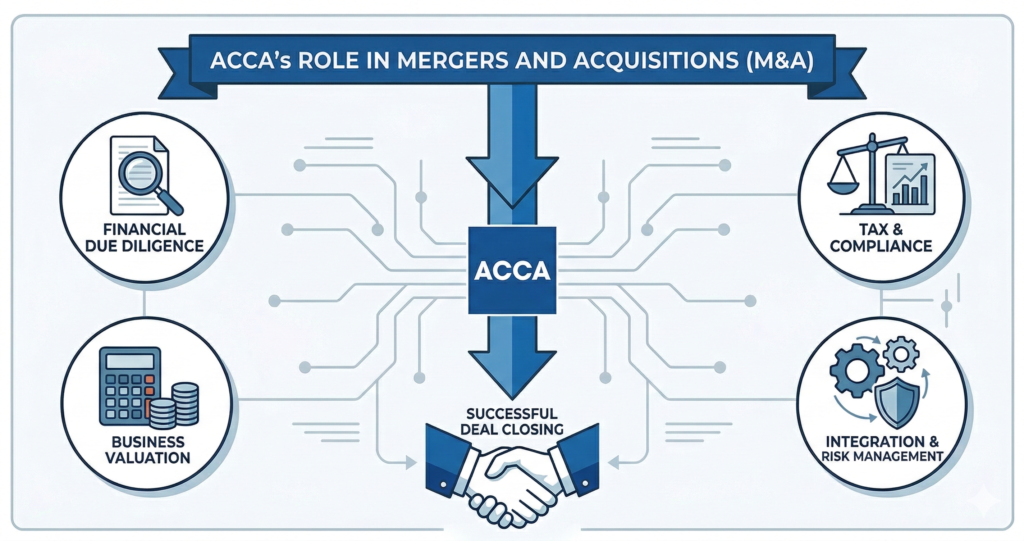
ACCA is officially recognized in over 180 countries, which makes it incredibly valuable for firms operating across multiple jurisdictions. This global recognition ensures that ACCA professionals can effortlessly work on international audits, cross-border M&A transactions, and global advisory projects without the need for extensive requalification.
2. Comprehensive Curriculum
The ACCA curriculum rigorously covers financial reporting, management accounting, corporate taxation, audit and assurance, enterprise risk management, ethics, and strategic leadership, making candidates exceptionally well-rounded. Unlike narrower accounting certifications, ACCA equips professionals with a powerful combination of:
-
Technical accounting knowledge
-
Commercial business insight
-
Strategic corporate judgment
-
Ethical grounding
This breadth ensures that ACCA charterholders can be deployed across auditing, consulting, corporate finance, and transaction advisory functions within global firms.
3. Emphasis on Ethics and Professional Conduct
Global firms operate under intense regulatory scrutiny. ACCA’s strong, foundational emphasis on ethics and professional conduct actively prepares candidates to handle modern governance challenges effectively. Recruiters heavily value this trait, especially for high-stakes roles in statutory audit, risk advisory, or regulatory compliance.
Career Paths in Big 4 and Global Firms for ACCA Professionals
The ACCA journey provides a highly structured pathway from entry-level execution to executive leadership. Common roles include:
| ACCA Level | Typical Big 4 Role | Core Responsibilities |
| Applied Knowledge & Skills | Audit Associate, Tax Associate, Financial Analyst | Learning methodologies, assisting statutory audits, preparing compliance reports. |
| Strategic Professional | Senior Auditor, Financial Consultant, Business Analyst | Leading audit engagements, advising corporate clients, performing deep financial variance analysis. |
| Fully Qualified ACCA Member | Audit Manager, Senior Advisory Manager, Finance Director | Managing large teams, high-level client advisory, driving strategic decision-making. |
This structure aligns perfectly with standard Big 4 career ladders, where professionals gradually move from technical execution to strategic advisory and leadership. To learn more about how we facilitate this transition, FinStreet’s training methodology ensures that students not only clear exams but also understand exactly how to position themselves for these elite career roles.
Real-World Example: ACCA in Big 4 Firms
Consider a professional joining a Big 4 firm as an ACCA trainee in the assurance practice. From their very first year, their rigorous ACCA training allows them to:
-
Interpret complex consolidated financial statements accurately.
-
Deeply understand risk-based audit procedures and international auditing standards (ISAs).
-
Actively advise clients on operational cost controls and financial risk implications.
As they progress to the Strategic Professional level, they become highly capable of managing small audit teams, leading direct client interactions, and contributing to broader business strategy. ACCA essentially accelerates readiness for leadership roles within global firms.
Several FinStreet alumni have successfully transitioned into senior managerial positions in Big 4 offices, crediting their ACCA background for enhanced credibility and significantly faster corporate promotions.
Soft Skills Development Through ACCA
Big 4 and global firms value soft skills just as much as technical financial knowledge. The ACCA qualification actively helps develop:
-
Problem-solving skills: Intensive case studies closely simulate real-world client scenarios.
-
Communication skills: Training in professional business reporting and advisory practice.
-
Decision-making skills: The Strategic Professional papers heavily emphasize professional judgment under uncertainty.
-
Leadership skills: The ethics and governance modules fundamentally build management and leadership capability.
FinStreet’s dedicated placement support integrates these critical soft skills into the learning journey so students enter global firms with immense confidence and practical corporate competence.
The ACCA Advantage Over Other Qualifications
| Evaluation Factor | ACCA | Other National Accounting Qualifications |
| Global Recognition | Universally recognized in 180+ countries | Often highly regional or strictly country-specific |
| Curriculum Scope | Accounting + Management + Ethics + Corporate Strategy | Primarily focused solely on bookkeeping or auditing |
| Leadership Preparation | Built-in via Strategic Professional papers | Limited focus; relies on on-the-job training |
| Employer Preference | Highly preferred in the Big 4 & global MNCs | May require additional bridging certifications for international roles |
This table clearly demonstrates why the ACCA credential is consistently the preferred choice for recruitment in prestigious, global organizations.
How FinStreet Prepares Candidates for Big 4 Careers
FinStreet goes far beyond standard exam preparation. For ambitious professionals targeting global firms, we provide:
-
Structured Guidance: Expert advice on which optional ACCA papers best align with specific Big 4 career paths (e.g., Advanced Audit vs. Advanced Financial Management).
-
Practical Training: Real-world case studies reflecting actual audit, management consulting, and transaction advisory scenarios.
-
Placement Support: Direct connections with top recruiters and talent acquisition teams in Big 4 and multinational firms.
-
Skill Development: Active coaching on executive leadership, analytical thinking, and high-level corporate communication skills.
This holistic approach ensures students do not just earn ACCA certificates, but also possess the exact practical skills that global recruiters actively seek.
Conclusion
The ACCA is much more than a professional accounting qualification; it is a direct gateway to elite global finance careers. Big 4 accounting firms and multinational corporations highly value ACCA candidates because they uniquely combine technical knowledge, commercial business insight, ethical grounding, and strategic thinking.
With structured guidance and career-oriented training from expert institutes like FinStreet, ACCA professionals can confidently pursue highly rewarding roles in audit, consulting, corporate finance, and advisory, while progressing rapidly toward senior leadership positions.
For aspiring global finance professionals, the ACCA is not just a credential—it is a strategic career investment that opens doors to some of the most prestigious and lucrative finance roles worldwide.
Ready to launch your Big 4 career? Explore how FinStreet can guide your ACCA journey today.