
Understanding the Prometric Test Center Experience for US CMA Exams

For most US CMA aspirants, Prometric exam day feels like standing at the departure gate of your global finance career. The room is quiet, the rules are strict, and every click on that screen converts months of preparation into future opportunities. With the right mindset, plan, and mentoring, that room stops being intimidating and starts feeling like the moment you have been training for with FinStreet.
Stepping Into Prometric: More Than Just a Test Center
Prometric is the global testing partner for the US CMA exam, delivering computer-based exams in a tightly controlled environment around the world. For serious candidates, understanding this environment is part of the strategy—not an afterthought.
- US CMA exams are conducted at authorised Prometric testing centers, not random local labs or colleges.
- Each center follows the same standardized procedures: check-in, identity verification, security screening, and monitored testing.
- The goal is simple: make sure every US CMA candidate, in every country, gets a fair, secure, and consistent exam experience.
FinStreet builds this reality into its training system, so your preparation is not just “book-smart” but exam-environment smart as well.
The Night Before: Where Real Confidence Starts
The Prometric experience starts long before you walk into the center. The night before your exam can make or break your performance.
Smart pre-exam checklist:
- Reconfirm your Prometric appointment email, test date, time, and center address.
- Keep your valid ID (usually passport) ready and double-check the name matches your IMA registration exactly.
- Plan your travel route, including buffer time for traffic, security, and check-in—aim to arrive at least 30 minutes early.
FinStreet mentors usually advise students to “close the books early” the previous evening and switch from cramming to light revision plus relaxation, so your mind is sharp, not overloaded, when you enter Prometric.
Ananya’s Story: First Time Inside Prometric
Ananya, a B.Com graduate from Pune, had spent months preparing for US CMA Part 1 with FinStreet. By the time her exam window arrived, she was scoring well in mocks—but she had one big fear: “What if I panic inside Prometric?”
Her mentor at FinStreet gave her a simple plan:
- Do one full 4-hour mock at the same time as her actual exam.
- Watch an exam simulation and walk through the Prometric interface beforehand so nothing on screen feels new.
- Use a written cue-card with a short breathing routine to use if anxiety spikes in the first 10–15 minutes.
On exam day, when she walked into Prometric, the check-in, lockers, and security checks felt serious but not scary—almost exactly how she had mentally rehearsed it during FinStreet mocks. That familiarity translated into calm, and calm translated into marks.
Exam Day: What Actually Happens at Prometric
Prometric centers run like clockwork. Knowing the sequence makes you feel like an insider, not a guest.
1. Arrival and Front Desk
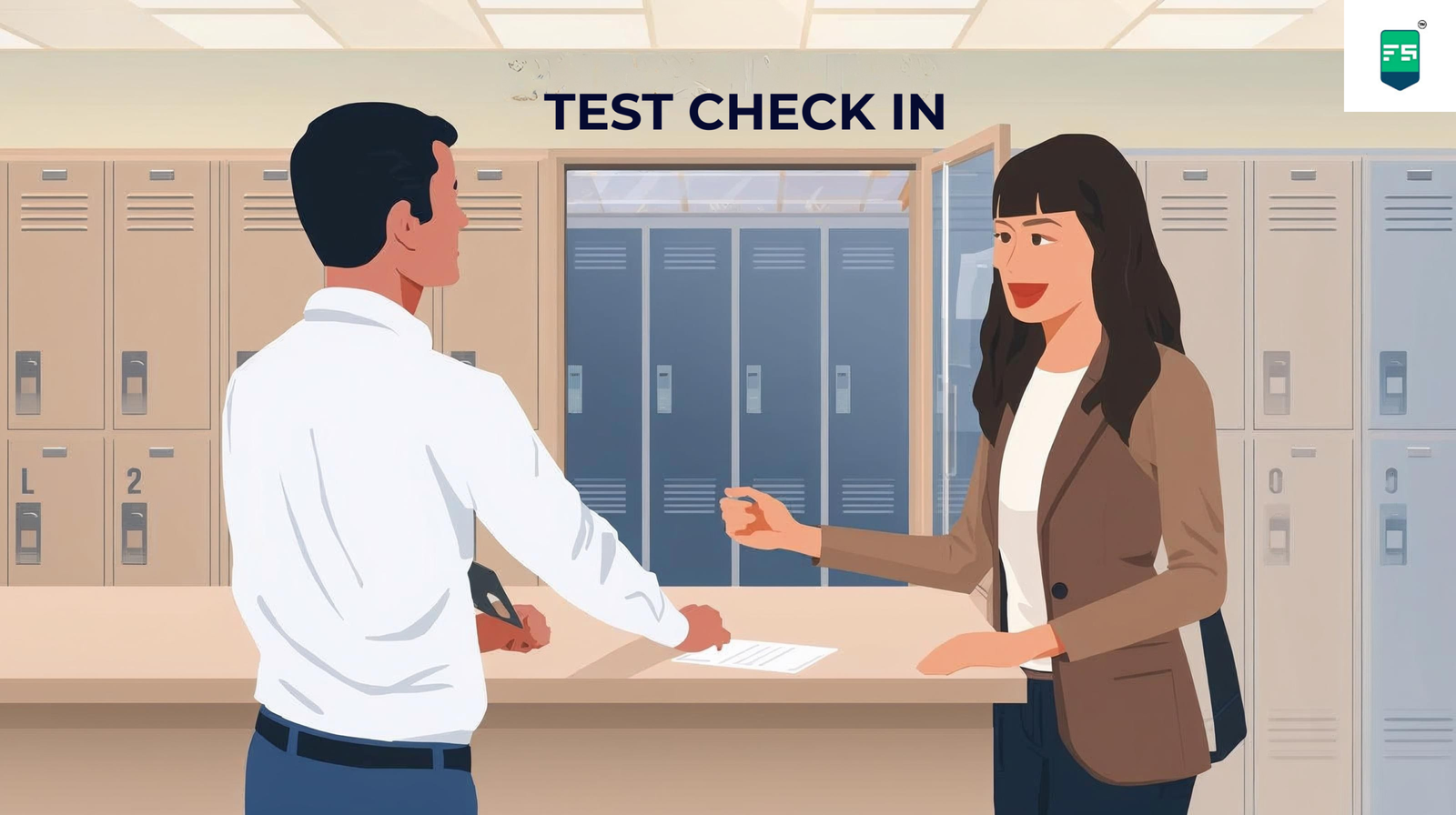
- You arrive at the center 30 minutes early, sign in, and present your valid ID as per the exam requirements.
- Staff verify your name, appointment, and documents, and then guide you through the next steps.
You may also be asked to sign a rules acknowledgment and confirm that you understand Prometric exam policies.
2. Locker and Personal Items
- You are assigned a locker to store your phone, bag, watch, notes, wallet, and other belongings.
- Only approved items can enter the exam room; the rest must stay locked away until you finish.
Even your basic accessories are treated seriously because Prometric’s job is to protect the integrity of the exam.
3. Security and Biometric Checks
Prometric security is strict by design.
- You may be asked to:
- Turn your pockets inside out.
- Raise your pant legs above your ankles.
- Roll up your sleeves and show your wrists and arms.
- Eyeglasses, jewelry, and other accessories can be inspected for hidden cameras or devices.
Once you pass this stage, you are escorted into the testing area.
Inside the Test Room: Your 4-Hour US CMA Arena
The testing room is quiet, cool, and heavily monitored. Every candidate sits at an individual computer workstation.
- Each station has a monitor, keyboard, mouse, and on-screen tools like a calculator and navigation buttons.
- CCTV cameras and proctors oversee the room, and you can raise your hand if there is any technical issue.
The US CMA Exam Flow
Although exact rules may vary slightly by policy updates, the broad structure for each US CMA part remains:
- 4-hour session at Prometric with 100 multiple-choice questions followed by essay scenarios.
- You start with MCQs; after meeting a minimum threshold, you are moved on-screen to the essay section.
A visible timer shows your remaining time, so pacing becomes a practical skill—one FinStreet builds aggressively through timed mocks and exam-day strategies.
Breaks, Rules, and Common Surprises
Many first-timers are surprised by how tightly controlled breaks are.
- You can usually take unscheduled breaks, but the exam clock keeps running.
- During breaks, you cannot discuss exam content or access notes or your phone; doing so can trigger an incident report.
- You must repeat partial security checks (pockets, eyeglasses, sleeves) every time you re-enter the test room.
Realizing this ahead of time helps you plan hydration, quick restroom visits, and mental resets in a practical way.
Quick Table: Your Prometric Experience in One Glance
| Stage | What You Experience |
|---|---|
| Before Exam Day | Registration, IMA approval, Prometric scheduling, travel and ID planning. |
| Arrival | Front desk sign-in, ID verification, appointment confirmation. |
| Locker Setup | Storing phone, bags, notes, watch, and gadgets in a secure locker. |
| Security Checks | Pockets, sleeves, pant legs, eyeglasses, accessories inspected. |
| Seated at System | Tutorial screen, interface familiarization, exam instructions. |
| During Exam | Timer-based MCQs and essays, optional breaks, proctor monitoring. |
| After Submission | Survey or confirmation screen, check-out, locker access, and exit. |
You cannot control the system, but you can absolutely control your readiness for each stage—and that is where FinStreet comes in.
The Prometric Test Drive: Dress Rehearsal for US CMA
One powerful but underused tool for reducing exam-day anxiety is the Prometric Test Drive.
- The Test Drive is a 30-minute “dry run” of the entire in-center experience: check-in, security, and a sample computer-based test using the same interface as your real exam.
- It does not test US CMA content; it tests your comfort with logistics, environment, and process, so nothing feels new on the real day.
Pair that with the official CMA exam simulation—an online tool that lets you practice navigation, question flags, and layout—and you dramatically cut down “technical uncertainty.”
FinStreet mentors often recommend this combination for students who are first-timers at Prometric or naturally anxious under timed, high-stakes conditions.
How FinStreet Re-Designs Your Prometric Journey
Prometric is just a location. The real differentiator is how prepared you are when you enter. FinStreet’s US CMA ecosystem is built to make that walk into Prometric feel like a natural next step, not a leap into the unknown.
1. Exam-Backwards Teaching and Planning
- FinStreet designs content and class flows based on the actual US CMA exam blueprint and question behavior, not just textbook order.
- Study plans are mapped backward from your chosen Prometric window—Jan–Feb, May–Jun, or Sep–Oct—so your revision peaks at the right time, not randomly.
Result: you do not just “finish the syllabus”; you peak strategically when you actually sit at Prometric.
2. Mocks That Feel Like Prometric, Not Coaching Class
- Full-length, 4-hour mocks are conducted under conditions that mimic exam reality: strict timers, no phones, minimal breaks, and immediate performance analytics.
- Post-mock analysis calls help you understand not just what you got wrong, but why—weak concepts, time mismanagement, or panic moments.
Many students share that by their second or third FinStreet mock, the idea of sitting at Prometric for 4 hours already feels normal.
3. Mentorship for Mindset and Career
FinStreet’s value is not only in academic support; it is in shaping how you think as a future finance professional.
- Mentors discuss exam-day psychology, decision-making under pressure, and recovery strategies after a tough section.
- Sessions connect US CMA concepts—budgeting, variance analysis, FP&A, strategic finance—to real corporate situations so your learning feels purposeful, not abstract.
That sense of purpose often becomes your anchor when you click “Start Exam” at Prometric.
Rahul’s Turnaround: From Panic to Precision
Rahul, a working professional in FP&A, attempted US CMA Part 1 once before joining FinStreet. His first attempt ended badly: he reached Prometric late, rushed through check-in, panicked during the first 30 MCQs, and never recovered.
When he came to FinStreet, the focus of the team was clear:
- Build a realistic schedule around his job, with clear milestones and mock targets.
- Recreate Prometric conditions during at least two mocks: same start time, same break structure, zero phone access.
- Walk him through a detailed “Exam Day Checklist” and help him plan his travel, food, and sleep schedule for the 48 hours around the exam.
The second time he walked into Prometric, nothing felt unfamiliar. He completed the MCQs on time, kept enough buffer for essays, and walked out feeling composed. When results came, he had crossed the passing threshold with room to spare.
That is the FinStreet difference: the same Prometric center, the same exam—but a completely different version of you.
Why FinStreet Should Be Your US CMA Partner
There are many institutes that can help you reach the exam. FinStreet’s ambition is to help you cross it—and then use US CMA as a springboard into a serious finance career.
What sets FinStreet apart:
- US CMA specialists: Focused on US CMA with deep understanding of exam behavior, not just generic accounting coaching.
- Mentorship-first approach: Small-group guidance, doubt-solving, and one-on-one strategy conversations that treat your attempt as a tailored project.
- Career lens: Regular discussions on roles like FP&A analyst, management accountant, and finance manager, so you connect Prometric day with your long-term growth.
Explore the US CMA program and upcoming batches here: https://finstreeteducation.com/.
Stay plugged into FinStreet’s ecosystem:
- Instagram: https://www.instagram.com/finstreeteducation/
- YouTube: https://www.youtube.com/c/FinStreetEducation
Use these channels to get weekly exam tips, success stories, and behind-the-scenes looks at how other students are preparing for their own Prometric day.
Your Next Step
Prometric is not the climax; it is the checkpoint that proves you are ready for a global finance career. Once you understand the environment, rules, and flow, your real competitive edge comes from structured preparation and strong mentorship.
If you are serious about making your US CMA attempt count:
- Enroll in FinStreet’s US CMA program today via https://finstreeteducation.com/.
- Book a free counselling session with FinStreet to plan your attempt window, Prometric date, and study roadmap.
- Join the FinStreet community on Instagram and YouTube for weekly US CMA insights, mindset content, and exam-day strategies.